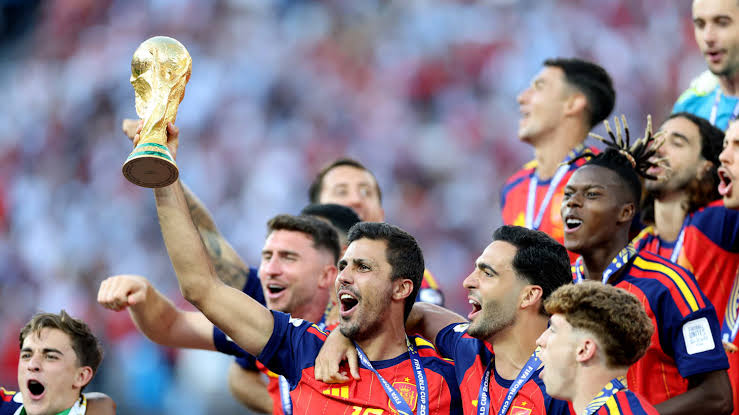
Spain are world champions once more. On Sunday, 19 July 2026, Luis de la Fuente’s side edged past a stubborn, ten-man Argentina 1-0 after extra time at the New York/New Jersey Stadium, sealing their second men’s World Cup title and completing a rare double alongside their reigning women’s crown.
It wasn’t the free-flowing spectacle many expected from two of football’s most storied nations. Instead, the final was a tense, attritional battle that only truly opened up once Argentina were reduced to ten men in stoppage time.
A Final Decided in the Margins
For long spells, this looked like it might be Emiliano Martinez’s night as much as anyone’s. The Argentina goalkeeper produced a string of outstanding saves to keep his side level, denying teenage sensation Lamine Yamal from a dangerous free-kick and repelling wave after wave of Spanish pressure. Remarkably, Argentina didn’t manage a single shot on target across the entire ninety minutes, with Martinez almost single-handedly keeping his side in the contest.
Spain, unsurprisingly, dominated the ball, controlling roughly three-fifths of possession and peppering Argentina’s goal with attempt after attempt. But a combination of Martinez’s heroics and some fine last-ditch defending kept the scoreline blank deep into the second half.
The turning point arrived in second-half stoppage time, when Argentina midfielder Enzo Fernandez was shown a second yellow card and sent off, leaving the defending champions to navigate extra time a man down. Moments later, Spain thought they had broken the deadlock through Nico Williams, only for the goal to be ruled out following a foul in the build-up.
Ferran Torres Writes His Name Into History
Spain refused to be denied. Just 37 seconds into the second period of extra time, substitute Ferran Torres found the breakthrough his side’s dominance deserved, rifling home the goal that would prove decisive. It was the strike that delivered Spain’s second men’s World Cup triumph — and, quite possibly, brought down the curtain on Lionel Messi’s international career.
From there, Argentina threw everything forward in search of an equalizer, but Spain’s defense — marshaled superbly throughout the tournament — held firm until the final whistle.
A Bittersweet Ending for Messi and Argentina
For Argentina, the anguish was written all over the faces of their players and supporters. Messi, chasing one final World Cup chapter, was left in tears as he collected his runners-up medal, with reports suggesting this could mark the end of his international career. Tempers frayed after the whistle too, with ugly scenes involving Argentina’s Leandro Paredes overshadowing what had otherwise been a hard-fought, respectful contest.
Spain’s Golden Era Continues
For Spain, this triumph is the crowning achievement of a golden generation. Sixteen years after their maiden World Cup win in 2010, De la Fuente’s side have now added the men’s world title to their recent European Championship success — and done so while their women’s team also holds the World Cup crown, an unprecedented feat in international football.
Captain Rodri lifted the trophy in New Jersey as wild celebrations erupted back home in Madrid, with a nation once again basking in the glow of global football supremacy.
Spain’s route to the title was defined by defensive solidity as much as attacking flair, and this final — won almost by a whisker — was a fitting microcosm of that balance: patient, composed, and ultimately clinical when it mattered most.
Want More World Cup Coverage?
Catch up on all the latest World Cup 2026 news, match breakdowns, and football stories on Sky247 NG — your home for football content that keeps you close to the action. Visit Sky247 NG today and stay in the loop.