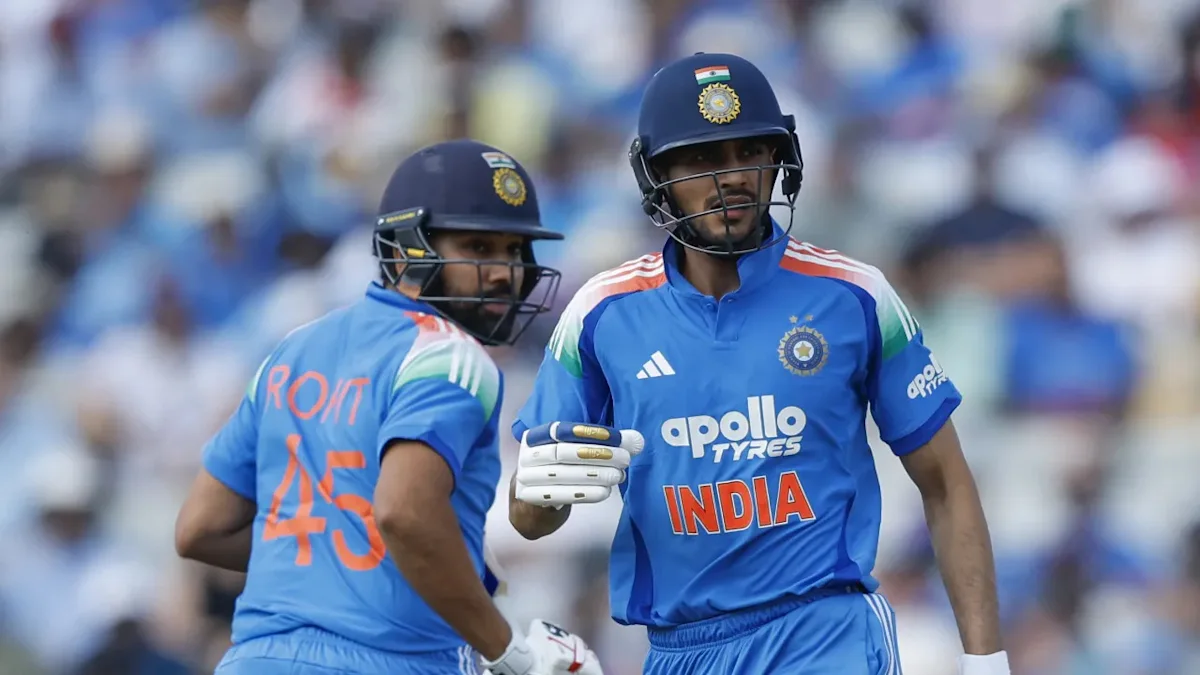
Spectators watching India’s ODI series against the West Indies observed a noticeable protrusion on the backs of multiple players, raising questions about the device. The device is a GPS performance tracker, typically worn in a pouch on a compression vest, and has now become a standard tool in contemporary elite cricket.
During the ODI series against West Indies, several Indian players were seen with a noticeable bulge on their backs, sparking curiosity among spectators. The device is a GPS performance tracker housed within a pouch on a compression vest, located between the shoulder blades.
It is commonly produced by STATSports. The tracker gathers several data points at the same time, including distance travelled during play and training, speed, acceleration, heart rate, and total player workload. The team management receives data from the unit in real time. The device is designed to manage player fitness, prevent injuries, and optimise training loads. In recent years, the use of such technology has become widespread in top-tier cricket facilities.
In practice, the information is sent to team management in real time. That enables analysts, physios, and conditioning coaches to compare match intensity with training loads, allowing them to modify recovery plans or workload targets as needed.
| Metric Tracked | What It Measures | Practical Use |
|---|---|---|
| Distance Covered | Total distance travelled during activity | Monitors overall workload and movement intensity |
| Speed | Running speed and high-speed efforts | Tracks running intensity and sprint demands |
| Acceleration | Changes in speed during movement | Measures explosive efforts and movement demands |
| Heart Rate | Heart rate during physical activity | Helps assess fitness, exertion and recovery |
| Player Workload | Overall physical demands placed on the player | Supports fatigue management and injury prevention |
India delivered a dominant performance in the first ODI at Greenfield International Stadium, Thiruvananthapuram, on September 27, 2026. West Indies scored 295 for 7 in their 50 overs, but India chased down the target with 8 wickets remaining, finishing with 50 balls to spare.
Kuldeep Yadav was awarded Player of the Match for his bowling performance, which included figures of 4/40. Kohli hit 126 off 85 balls, featuring 10 fours and 7 sixes, while chasing the target. That innings matched Sachin Tendulkar’s record of 60 List-A centuries.
Since 2006, the West Indies have not secured a bilateral ODI series victory against India, and they haven’t won any such series on Indian soil since 2002. With the three-match ODI series now complete, focus shifts to the five-match T20I series, scheduled until October 17, 2026, with Iyer at the helm for India in that format.
India’s T20I squad:
Shreyas Iyer ( c), Abhishek Sharma, Vaibhav Sooryavanshi, Ishan Kishan ( wk), Sanju Samson ( wk), Tilak Varma ( vc), Shivam Dube, Kuldeep Yadav, Axar Patel, Ravi Bishnoi, Nitish Kumar Reddy, Arshdeep Singh, Prince Yadav, Mayank Yadav, Naman Dhir